
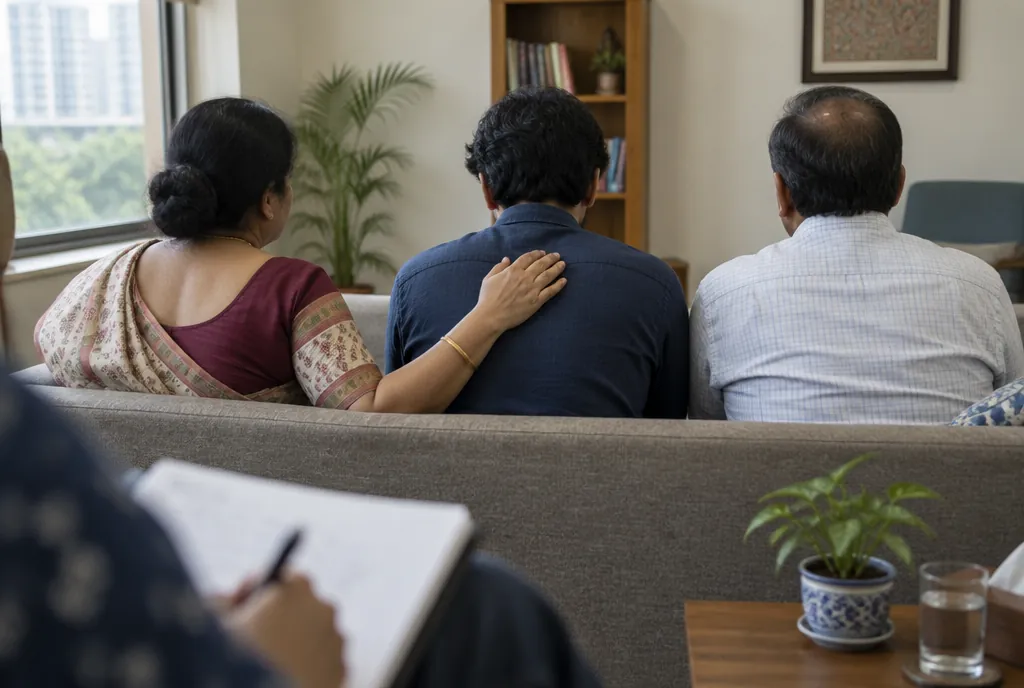
Most families start looking for a nasha mukti kendra in the middle of a crisis: after a hospital visit, a lost job, a frightening night. That is exactly when it is hardest to judge a centre clearly – and when a confident voice on the phone promising to ‘handle everything’ sounds most reassuring.
This is the checklist we would want any relative to have before admitting someone they love. In short, a safe nasha mukti kendra is registered under the Mental Healthcare Act 2017, has a psychiatrist directing medical care (including detox), offers real therapy and family work, respects the patient’s rights, and plans for life after discharge. A centre that locks people in, promises a guaranteed result or keeps the family away is one to walk away from, however convenient it seems.
What a good nasha mukti kendra should provide
‘Nasha mukti kendra’ simply means de-addiction centre. The name tells you nothing about quality; the people and the programme do. Good residential treatment usually includes:
- A medical and psychiatric assessment on admission – physical health, which substances and for how long, any previous withdrawal, and any depression, anxiety or other condition running alongside the addiction.
- Medically supervised detox where it is needed. Stopping heavy, long-term drinking abruptly can be dangerous: the US National Institute on Alcohol Abuse and Alcoholism (NIAAA) warns that withdrawal can be painful or even life-threatening, with seizures among the possible symptoms. Opioid and sedative dependence need medical management too. Detox is a doctor’s job, not something counsellors or wardens should handle alone.
- A psychiatrist who actually sees the patient, working alongside clinical psychologists and trained counsellors.
- Structured therapy, not just rest and rules. NIAAA lists approaches such as cognitive behavioural therapy, motivational enhancement and family counselling among evidence-based behavioural treatments.
- Family sessions, because addiction changes the whole household – and the household shapes recovery.
- An aftercare plan: follow-up appointments, relapse-prevention work and a clear route back if things go wrong.
Not everyone needs to be admitted. Many people do well with outpatient treatment; others need a residential stay. We compare the two in inpatient vs outpatient de-addiction treatment.
Is the rehab centre registered? What the law says
This is the first question to ask and the easiest to check. Under the Mental Healthcare Act 2017, ‘mental illness’ expressly includes mental conditions associated with the abuse of alcohol and drugs, and a ‘mental health establishment’ covers any place where people with mental illness are admitted and live for care, treatment or rehabilitation. In practice, that brings residential de-addiction centres within the Act.
Three provisions matter most to families:
- Registration is compulsory. Section 65 says no person or organisation shall establish or run a mental health establishment unless it is registered with the Mental Health Authority. For a private centre in Uttar Pradesh, that means the State Mental Health Authority.
- The certificate must be on display. Section 70 requires the registration certificate to be displayed where everyone visiting can see it. Section 72 requires the contact details of the Mental Health Review Board to be displayed too, including on the centre’s website.
- Running without registration is penalised. Section 107 sets penalties for operating an unregistered establishment, rising for repeat contraventions, and a separate penalty for any mental health professional who knowingly works in one.
A registered centre should show you its certificate without hesitation. Hesitation is itself an answer.
The rights your relative keeps inside a rehab
Admission does not suspend a person’s rights. The Act protects several that matter directly in de-addiction care:
- Dignity and safety (Section 20): a safe and hygienic environment, privacy, no forced work, no compulsory head-shaving, and protection from all forms of physical, verbal, emotional and sexual abuse.
- Contact with the outside world (Section 26): the right to receive or refuse visitors and to make and receive phone calls at reasonable times, subject to the centre’s norms. Sensible phone rules are normal; cutting someone off completely is not.
- No chains, no isolation (Sections 95 and 97): chaining is prohibited ‘in any manner or form whatsoever’, and seclusion and solitary confinement are not allowed. Physical restraint is allowed only as the sole way to prevent imminent harm, authorised by the treating psychiatrist and recorded – never as punishment or because staff are short.
- Leaving (Section 88): someone admitted voluntarily must be discharged on request, though a mental health professional may hold the discharge for up to 24 hours to assess whether supported admission is needed.
We explain the rest of the Act in plain terms in your rights under the Mental Healthcare Act 2017.
10 questions to ask before admission
Ask these on the phone, then again in person. Visit if you possibly can, and ask to see where patients sleep, eat and spend the day.
- Are you registered under the Mental Healthcare Act? Can I see the certificate?
- Who is the psychiatrist, and how often will they see my relative? Ask whether a doctor is available at night and at weekends.
- How do you manage detox? Who monitors withdrawal, what happens if there is a fit or sudden confusion, and which hospital do you transfer to in an emergency?
- What does a typical day look like? Which therapies, delivered by whom, and how many individual sessions each week?
- Will other conditions be assessed? Depression, anxiety, trauma and sleep problems often travel with addiction and need treatment too.
- How is the family involved? Look for regular family sessions, not just visiting hours.
- What are the rules on phone calls and visits? Weeks of no contact ‘for the patient’s own good’ is a warning sign.
- Do you ever use restraint or isolation? The only acceptable answer: rarely, as a last resort, authorised by a psychiatrist and recorded – never locked rooms or chains.
- What is the total cost, in writing? Ask what is included – medicines, tests, therapy, family sessions – and what is extra. Our guide to de-addiction and rehabilitation costs in Noida explains what drives the price.
- What happens after discharge – and after a relapse? NIAAA suggests asking every provider how they handle a return to drinking. A good centre has a better answer than ‘then they have failed’.
Rehab centre red flags: when to walk away
- A ‘guaranteed cure’ or a fixed success rate. Addiction is a long-term condition; honest services talk about treatment and recovery, not guarantees.
- No psychiatrist, or one who ‘visits sometimes’.
- No detox plan, or the suggestion that a heavy drinker can simply stop on arrival.
- Forced pick-ups – teams that arrive at night to take an adult away against their will. Under the Act, admission without consent is possible only in narrow circumstances, after independent assessments by a psychiatrist and a second professional, with time limits and review. Paying a pick-up service is not one of them.
- Locked rooms, chains, beatings or head-shaving – each one prohibited by the Act.
- No contact for weeks, or refusal to let you see where your relative will live.
- Large cash advances and no written bill.
- Reluctance to show the registration certificate.
These warnings are not hypothetical. In 2023 the National Human Rights Commission reported deaths of inmates at private de-addiction centres – including earlier incidents in Noida and Ghaziabad – and issued notices to every state and union territory, questioning whether enough safety measures were in place. In November 2025, The Tribune reported that police and a medical team in Punjab found 25 young people kept in a locked room at an unauthorised centre, which was then sealed.
Free helplines and government support
Two free national helplines can help. The Ministry of Social Justice and Empowerment runs a toll-free de-addiction helpline, 14446, for counselling and referral, and funds de-addiction services under its National Action Plan for Drug Demand Reduction (PIB). For emotional distress at any hour, Tele-MANAS (14416) is free, available 24/7 and offered in 20 Indian languages (Ministry of Health and Family Welfare).
If someone has a fit, becomes confused or starts seeing things after stopping alcohol, or may have overdosed, do not wait for a rehab bed: call 112 or go to the nearest emergency department.
Frequently asked questions
Is a nasha mukti kendra the same as a rehab centre?
In everyday use, yes – both mean a place offering de-addiction treatment, usually with a residential option. What varies enormously is quality. Judge any centre by its registration, whether a psychiatrist leads medical care, how detox is handled, what therapy is offered and how the family is involved – not by its name or its brochure.
How do I check if a rehab centre is registered?
Ask to see the registration certificate: the Mental Healthcare Act 2017 requires it to be displayed where visitors can see it. Note the registering authority and certificate details, and if anything seems wrong, contact the State Mental Health Authority. A centre that cannot or will not show you its registration should not be trusted with your relative.
Can a de-addiction centre keep someone against their will?
An adult admitted voluntarily must be discharged on request, although a professional may hold them for up to 24 hours for an assessment. Admission without consent is lawful only under the Act’s supported-admission rules, with independent assessments, time limits and review. Keeping someone locked in because the family asked is not one of them.
Should my relative stop drinking before admission?
Not if they drink heavily every day. Stopping suddenly can trigger dangerous withdrawal, including fits. Tell the centre honestly how much and how often they drink, and let doctors plan the detox. Our guide to alcohol withdrawal and safe detox explains the warning signs. For shaking with confusion, hallucinations or a fit, call 112.
How long does treatment at a nasha mukti kendra take?
It depends on the substance, how severe the dependence is, physical health and any other conditions, so be wary of a centre that quotes a fixed package before it has assessed your relative. Detox is usually the shortest part; therapy, family work and aftercare take longer. Our page on how long rehab takes explains the stages.
Choosing a de-addiction centre in Noida
SSHIMOH is a psychiatrist-led de-addiction centre in Noida, in Sector 117, open 24/7, with inpatient and outpatient care and both in-clinic and online consultations. We would rather you asked us every one of the ten questions above than admitted anyone on trust – including to us.
If you are not yet sure whether your relative needs admission at all, start with an assessment. Book an appointment or call or WhatsApp +91 72669 93399, and our team will talk through what fits your situation.
Sources
- The Mental Healthcare Act, 2017 – full text (National Health Systems Resource Centre, MoHFW)
- NIAAA – Treatment for Alcohol Problems: Finding and Getting Help
- National Human Rights Commission – Human Rights Newsletter, May 2023 (deaths of inmates in private drug de-addiction centres)
- The Tribune – Illegal drug de-addiction centre busted, 25 youths held captive in room rescued (November 2025)
- PIB, Ministry of Social Justice and Empowerment – Alcohol and drug addiction in children (17 December 2024)
- PIB, Ministry of Health and Family Welfare – Advancing Mental Healthcare in India (7 February 2025)
General information, not a diagnosis or medical advice. This article summarises the law in general terms and is not legal advice. If you or someone you know is in immediate danger, call 112 or go to the nearest emergency department; for free 24/7 mental health support, call Tele-MANAS on 14416.