
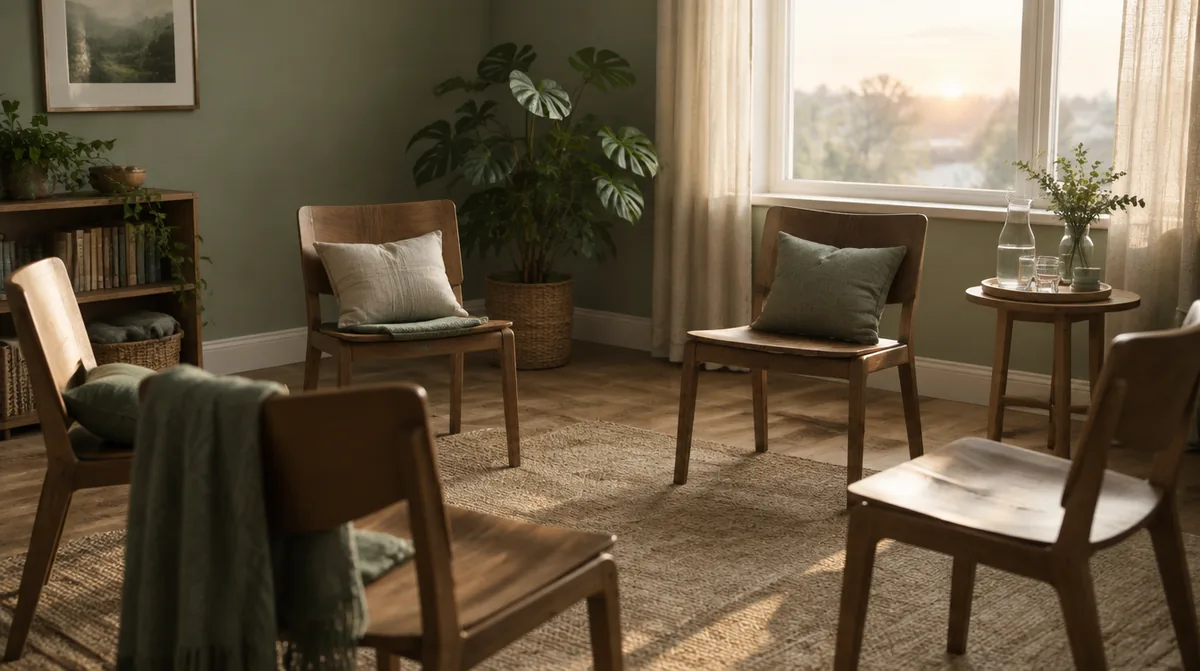
People imagine one of two things. Either a hospital ward — beds, drips, locked doors. Or something closer to a wellness retreat, with yoga at dawn and herbal tea.
It is neither. A good residential programme looks more like a very structured shared house where almost every hour has a purpose, and where the structure itself is doing some of the therapeutic work.
Here is the honest version, including the parts nobody puts in a brochure.
Why the routine matters
Before the timetable, the reason for it.
Most people arriving in residential treatment have spent months or years with no reliable shape to their days. Sleep has inverted. Meals happen or do not. Whole afternoons disappear.
Re-establishing a predictable rhythm does several things at once: it stabilises sleep and appetite, it removes the constant small decisions that are exhausting when you are unwell, and it creates the conditions in which therapy can actually land. You cannot do meaningful psychological work at four in the morning on no sleep.
So when residents complain that the schedule is rigid — and they do, often in the first week — the rigidity is not administrative convenience. It is the intervention.
The shape of a typical day
Every centre runs its own timetable. The outline below is typical of residential programmes; at SSHIMOH, the team explains the exact daily schedule, phone and visiting arrangements before admission.
Morning
Early start, at a consistent time. Not punitively early, but earlier than most people have been managing. Personal care, then breakfast as a group rather than alone.
Mornings usually include some form of check-in — a short group where each person says how the night went and how they are. It sounds slight and it does a lot: it catches deterioration early, and it gets people used to saying something true out loud.
Medical review happens in the morning for those who need it, particularly anyone early in detoxification, where observation needs to be frequent.
Mid-morning to lunch
The main therapeutic block. Depending on the day and the person, this is group therapy, individual sessions with a psychologist or psychiatrist, or structured psychoeducation — understanding what dependence actually is, what withdrawal is doing, what triggers relapse.
Group work does most of the heavy lifting in addiction treatment, which surprises people who assumed individual therapy would be the core. Being in a room with others who recognise your excuses is harder to argue with than a clinician.
Afternoon
Usually more varied — activity, physical exercise, structured recreation, skills-based sessions, or family sessions where relatives attend.
Physical activity is not filler. Sleep, mood and appetite all respond to it, and for people whose bodies have taken a long period of damage, gentle rebuilding is part of recovery rather than separate from it.
Evening
Dinner together, then something lower-key — a reflective group, a mutual-aid meeting, quiet time, supervised phone contact where permitted.
Lights out at a set time. For many residents, sleeping normally for the first time in years happens here, and it is frequently the first change they notice.
The parts people do not expect
It is often boring
This is the most common surprise, and worth saying. After the first intense days, there is a stretch where very little feels like it is happening. Residents describe restlessness and impatience.
That stretch is normal and it is not wasted. Sitting with discomfort rather than escaping it is close to the whole skill being learned.
The other residents matter as much as the staff
Most people arrive expecting the clinicians to be the active ingredient. Afterwards, they usually talk about the other residents — the ones further along who made it look possible, and the ones newer than them whom they ended up helping.
Privacy is limited
Shared rooms are common. Belongings are checked on admission. Phone access is typically restricted, especially early on. This is the part families most underestimate and residents most resent at first. The reasoning — reducing access to supply and to the relationships that sustain use — is sound, and it is still an adjustment.
Family work is part of it, not an add-on
Patterns at home often maintain the problem without anyone intending it. Programmes that involve families tend to produce better outcomes than those that treat the person in isolation. The National Institute on Drug Abuse describes treatment as needing to address more than substance use alone.
How it changes over a stay
The first days are mostly medical — stabilisation, managing withdrawal, sleep. Therapy barely registers because the person is not yet in a state to use it.
The middle stretch is the therapeutic core, and also where motivation dips hardest. People feel physically better and start questioning whether they need to stay.
The final phase shifts toward leaving: relapse prevention, identifying personal triggers, planning the first weeks at home, arranging follow-up. This is the part that determines whether the stay was worth it, and it is the part people are most tempted to rush. See relapse prevention.
Who you are actually dealing with
"The staff" is several different jobs, and knowing which is which saves a good deal of confusion.
- The psychiatrist makes diagnostic and medication decisions and reviews progress. Usually seen at defined intervals rather than daily, once the acute phase has passed.
- The nursing team is the constant presence — observations, medication rounds, and the people you tell at three in the morning that something is wrong.
- Psychologists and therapists run individual and group sessions. This is where most of the psychological work happens.
- Counsellors, in many Indian facilities including some with their own experience of recovery, run groups and day-to-day support.
- Support staff — catering, housekeeping, security. Residents mention them afterwards more often than you would expect, because ordinary kindness registers strongly when you are struggling.
A reasonable question to ask any facility before admission: how often does a psychiatrist actually review each resident? The answers vary considerably more than the brochures suggest.
What is expected of you
Residential treatment is not something done to you while you wait. A typical programme expects:
- Attendance. Groups and sessions are not optional extras.
- Participation, eventually. Nobody is made to speak on the first day, but sitting silently for a month is not treatment either.
- Your share of running the place. Making your bed, clearing up, taking a turn at shared tasks. This reads as petty until you understand it: the return of small daily competence is part of recovery, not a chore bolted on to it.
- Honesty about cravings and slips. Concealing them is the most reliable way to waste the stay.
- Tolerating other people. You will share space with people you would not have chosen. Managing that is itself the practice.
Weekends usually run a lighter schedule — fewer formal groups, more recreation, often visiting. Some residents find weekends harder for precisely that reason, because unstructured time is where difficulty tends to surface.
Frequently asked questions
Can I use my phone?
Usually restricted, particularly in the early period, with supervised contact permitted. Policies vary between facilities — ask directly before admission rather than assuming.
Can my family visit?
Most programmes have defined visiting arrangements and family sessions. Ask what they are at the outset, because it is a common source of friction when assumed rather than checked.
Is it locked?
Arrangements differ, and depend on whether admission is independent or supported. This is a fair question to ask plainly, and any reputable facility will answer it plainly.
What if I cannot sleep?
Expected early, particularly in withdrawal, and managed medically. Tell staff rather than enduring it; sleep is treated as clinically important, not as a comfort issue.
How long is a typical stay?
It varies considerably with the substance, the severity and whether there is a co-occurring mental illness. Anyone quoting a single number before assessing the person is guessing.
If you are weighing this up
The question worth asking is not whether the days sound pleasant. It is whether the structure is something you currently cannot build on your own — because for most people entering residential care, that is precisely the problem.
If outpatient treatment might be enough, inpatient vs outpatient treatment covers how that decision is made. For how admission itself works at our de-addiction centre in Noida, see the admission process.